

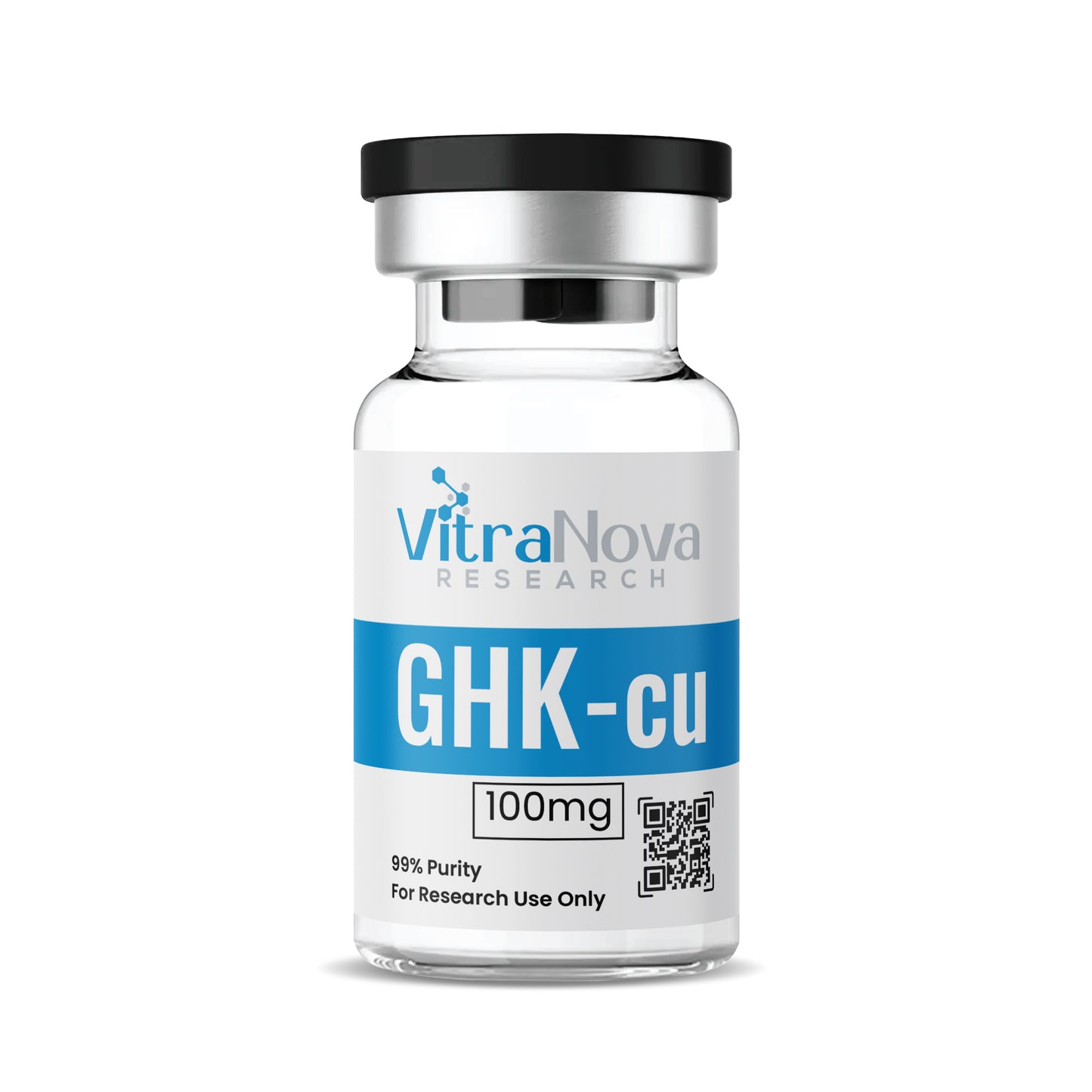
GHK-cu | 100mg
GHK-cu | 100mg
Enhanced Tissue Remodeling
Guaranteed >99% Purity
High-Potency 100mg
BUNDLE & SAVE
Research Disclaimer: Not for human or Veterinary Consumption
Couldn't load pickup availability

GHK-cu | 100mg
Description
Description
Regeneration. Structure. Purity.
VitraNova Research introduces GHK-cu Core, a high-concentration 100mg formulation of the copper-binding peptide GHK (glycyl-L-histidyl-L-lysine). Widely researched for its role in tissue remodeling and collagen synthesis, our GHK-cu is synthesized to meet the rigorous demands of laboratory investigation.
Each vial contains a substantial 100mg quantity of the compound, verified to meet or exceed 99% purity for consistent experimental results.
- High Potency: 100mg of active research reagent per vial.
- Purity Verified: >99% purity confirmed via analysis.
- Research Grade: Formulated strictly for laboratory use.
Specifications
Specifications
Product Name: GHK-Cu Core
Net Content: 100 mg
Compound Type: Copper-binding tripeptide (Glycyl-L-Histidyl-L-Lysine)
Purity: >99% (analytically verified)
Form: Lyophilized powder
Grade: Research use only
Potency: High-potency 100 mg active compound
Packaging: Medical-grade glass vial
Stability: Lyophilized to preserve chelation integrity
Intended Use: Tissue remodeling, collagen synthesis, and extracellular matrix research
Storage: Store in a cool, dry place away from light
Compliance: Not for human or veterinary consumption

Optimizing Collagen and Extracellular Matrix Research
VitraNova Research presents GHK-cu Core as a definitive reagent for studying tissue regeneration and structural integrity. As a copper-binding tripeptide (glycyl-L-histidyl-L-lysine), GHK-cu is critical for investigating the upregulation of collagen, elastin, and glycosaminoglycans. Our formulation preserves the peptide’s chelation properties, enabling researchers to precisely evaluate its influence on wound healing cascades, antioxidant enzyme activation, and the remodeling of the extracellular matrix without the variability introduced by unstable compounds